
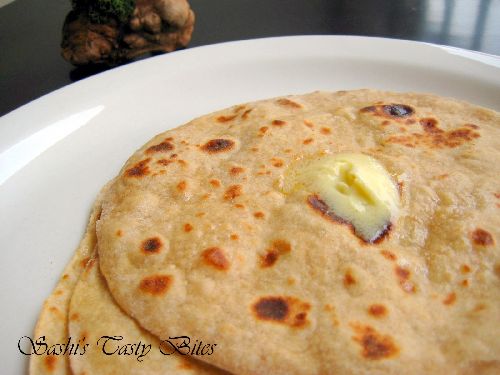
Making soft chapati is simple once you get a feel for the dough, although it took me quite a few trials to learn what worked best. Over time, I picked up a few useful tips that helped me make softer chapatis that puff nicely on the griddle.
Chapati is a versatile whole-wheat flatbread that pairs well with almost any vegetable curry, dal, or non-vegetarian gravy. It can also be part of a balanced meal depending on the portion size and accompaniments.
Whole Wheat Flatbread / Chapati
Recipe Details
Flatbread
Indian
Sashi
20 minutes
3
The dough also rests for about 30 minutes before rolling.
Ingredients
- Whole wheat flour – 4 cups, plus extra for dusting
- Salt – 1/2 tsp
- Water – 1 1/2 cups, added gradually as needed
- Oil – 1 tsp
- Ghee or butter – 2 tbsp (optional)
Prepare the Dough
- Add the whole wheat flour and salt to a wide mixing bowl.
- Add the water little by little while mixing and kneading until a soft dough forms.
- If the dough is excessively sticky, sprinkle in a small amount of extra flour and continue kneading. Avoid adding too much flour, as a stiff dough can make the chapatis dry.
- Knead well until the dough becomes smooth and pliable.
- Add the oil and knead once more until it is incorporated.
- Cover the dough and allow it to rest for about 30 minutes.
Rolling the Chapati
- Divide the dough into small lemon-sized portions and roll each portion into a smooth ball.
- Flatten one ball slightly with your fingers.
- Lightly dust it with whole wheat flour and place it on a rolling surface.
- Roll it into a thin, even circle, turning it occasionally so it does not stick to the surface.
- Use only as much dusting flour as needed to prevent sticking.
- Repeat with the remaining dough portions.
Cooking Instructions
- Heat a griddle or tawa over medium-high heat.
- Place one rolled chapati on the hot griddle.
- Cook until small bubbles begin to appear on the surface, then flip it.
- Cook the second side for about 20–40 seconds.
- Flip once more. The chapati should begin to puff as steam forms inside.
- If needed, gently press the edges with a clean kitchen towel or spatula to encourage even puffing.
- Remove the chapati once both sides have light brown spots and are cooked through. Avoid leaving it on the griddle too long, as overcooking can make it dry or crisp.
- Brush lightly with ghee or butter, if desired.
- Keep the cooked chapatis covered in a clean kitchen towel or insulated container while preparing the remaining ones.
Optional Direct-Flame Method
After partially cooking both sides on the griddle, the chapati can be placed briefly over a low open gas flame using tongs. Turn it carefully until it puffs, then remove immediately. Use caution around the open flame.
Tips
Soft Dough: A soft, well-kneaded dough is one of the most important factors for making tender chapatis.
Rest the Dough: Allowing the dough to rest for about 30 minutes relaxes the gluten and makes rolling easier. Refrigeration is not required for a short rest.
Roll Evenly: An evenly rolled chapati is more likely to puff properly because steam can spread throughout the flatbread.
Hot Griddle: Use a properly heated griddle. Cooking too slowly can dry out the chapati before it has a chance to puff.
Do Not Overcook: Remove the chapati as soon as it is cooked and has light brown spots. Excessive cooking can make it crisp.
Keep Covered: Stack freshly cooked chapatis and keep them covered so they remain warm and soft until serving.
Serving Suggestion
Serve soft chapatis with vegetable curry, dal, kurma, chicken curry, mutton gravy, or any other favorite Indian side dish.


Leave a Reply